What Is the Worlds Most Popular Martial Art? Answerscom

Indonesian martial arts includes a multifariousness of fighting systems native to or developed in the archipelago of Indonesia, both the age-old traditional arts, and the more recently developed hybrid combatives. In the Indonesian language the term bela-diri (lit. self-defense) is used to mean martial fine art, and in essence the Indonesian fighting arts are meant as one's defence against perceived threat and assault. Other than physical training, they often include spiritual aspects to cultivate inner strength, inner peace and higher psychological ends.[1]
Today, Indonesian fighting styles are synonymous with pencak silat, a term coined for the martial arts of the Indonesian archipelago.[2] Nonetheless, a number of fighting arts in Indonesia are not included within the category of silat. Western misconception links silat with "jungle tribes" just in actuality, pencak silat was neither created nor traditionally practised by Indonesia'due south tribal inhabitants, many of whom have unique martial arts of their own. Some of these traditions have been preserved as a complete fighting system, eastward.g. pencak silat and kuntao. Other methods are either no longer proficient or only exist in a more than sportive form such as the spear-throwing of pasola or the dance of cakalele.
History [edit]

Battle scene on bas-relief of Penataran, Majapahit era
Some parts of the archipelagic realm that is today Republic of indonesia was the scene of warfare among the native populace for much of its long history, and the people of the region naturally adult constructive methods of combat and cocky-defense force.[1] Archaeological findings dating from prehistoric times take uncovered a variety of stone and metallic weaponry such as axes, arrows and spearheads. These implements would have doubled as hunting tools and weapons of combat between and among tribes. Tribal warfare, although often motivated past resources, lands and slave grabbing, was besides a solution to settling disputes, as well as a component of coming of age rituals. The practice of headhunting developed the martial skills of some tribes to a loftier level such as the Dayak, Batak, and Nias people. Warriors from militaristic tribes were appreciated by other factions, and were recruited by adult kingdoms and polities as mercenaries. Traditional war dances were used both to reenact battles and as a form of training, a precursor to the preset forms or jurus of afterwards fighting systems. Displaced Baiyue from nowadays-day People's republic of china and Vietnam (particularly the Dong Son civilization) during the first centuries of the common era introduced bronze-casting to the Nusantara and resulted in the evolution of native edged weapons such as the parang, klewang, mandau, badik, kujang, golok and kris. Chinese straight swords arrived early, and aboriginal Javanese curved swords show Indian derivation.
Contact with India and the forming of aboriginal kingdoms lead to the transition from tribalism to the gilded age that was Indonesia'due south Dharmic civilization. Pencak silat developed in this era[ vague ], spreading quickly from Sumatra into virtually the whole of the archipelago. In comparison to the country's tribal fighting systems, pencak silat shows decidedly more influence from the Asian mainland, specifically Cathay and the Indian subcontinent. Pencak silat tied the fine art of gainsay with practices of meditation and spiritual development, calculation a new layer to the martial arts bated from merely being used to fight or kill so that information technology was used consistently throughout Indonesia's history.[3] The wide geographical surface area in which pencak silat was practiced is naturally reflected in its diverseness of techniques and weaponry, some indigenous and some adopted from outside through maritime trade. Chinese communities continued to institute themselves, their native kuntao influencing the local martial arts.
Gunpowder technology in cannons and muskets allowed many kingdoms and polities in Indonesia to exist conquered and subjugated by European power. A further influx of Chinese were brought in every bit labourers, increasing the proliferation of kuntao styles. But while the Europeans could effectively overtake and hold the cities, they constitute it incommunicable to command the smaller villages and roads connecting them. Indonesians took advantage of this, fighting an underground war through guerilla tactics. Equally guns were not widely bachelor, indigenous blades were used in these attacks. Folklore portrays the rebels as Robin Hood-like martial artists such as Si Pitung. After Indonesia won its independence from colonization, the role of martial arts like pencak silat in nation-edifice was recognized. The Indonesian Pencak Silat Association (IPSI) was founded to unite the country's pencak silat schools nether a unmarried governing body. It has been incorporated into the unarmed combat training of Indonesia's polce and military, besides as existence an extra-curricular activity in schools, and a gainsay sport in athletic events. Many of the more violent martial practices such as headhunting and duels to the death either brutal out of popularity or were banned. A number of fighting styles have managed to survive by adapting. In some cases they became less lethal similar pasola, or at times by beingness promoted as a dance for the amusement of tourists.
Systems [edit]
The post-obit are complete martial arts designed for fighting or self-defense.

Pencak Silat [edit]
Pencak silat is a chemical compound of the two nearly unremarkably used words for martial arts in Indonesia. Pencak was the term used in fundamental and e Java, while silat was used in Sumatra and Borneo. In modern usage, pencak and silat are seen as being ii aspects of the aforementioned practice. Pencak is the essence of preparation, the outward attribute of the fine art. Silat is the internal essence of combat and self-defense, the true fighting application of the techniques.[4] The earliest show of pencak silat is in 6th-century Riau from where it saw farther development under Indian and Chinese influence in the Hindu-Buddhist kingdoms of Sumatra and Coffee. The art gradually spread throughout most of what is now Republic of indonesia and reached its superlative in the medieval Majapahit kingdom. Generalizations of silat techniques are difficult due to the diverseness of systems. Whatsoever part of the torso is used and subject field to set on. Strikes, grabs, locks, and weapons are all incorporated. Training is often supplemented with internal methods of development such as meditation.
Kuntao [edit]
Kuntao is a Hokkien term for martial arts, in this example referring to those practised past the Tionghoa customs of the Indonesian archipelago. Kuntao has a long history in the region dating back to ancient times. Such has been the influence between kuntao and pencak silat that the terms are used interchangeably in some regions. Every Chinese customs in Indonesia either has or historically had some style of kuntao, but they were not taught openly until the latter half of the 20th century. Northern and southern Chinese martial arts are represented in kuntao, both from the external and internal schools. Some systems were direct imported from Prc and underwent little or no changes, such as thaikek (taiji), pakua (baguazhang or viii-trigram palm) and peh-ho (baihequan or white crane fist). Other popular systems originate from the same states as the Chinese communities who practise them, so that Fujian, Shandong, Kongfu and Guangdong styles dominate.
Caci [edit]

Caci duel using rattan whip as weapon and shield equally protection.
Caci (pronounced "chachi") is a class of fighting with a whip or stick.[v] It appears to be ethnic to Flores in East Nusa Tenggara, but it is also practiced in Bali and Lombok.[5] The art is sometimes chosen cacing or ende in Flores, and larik or kebat in Riung, while in Balinese it is known equally ende. The term caci is said to derive from the Manggarai words ca meaning one and ci meaning examination, indicating a 1-on-i exam between the fighters. According to local folklore, caci during festivals began with ii brothers who owned a buffalo. When the younger blood brother roughshod into a deep pigsty, the older brother had to slaughter the buffalo to get its skin to help his sibling escape from the pigsty.[6] The customs celebrated this human activity of dear with a festival in which caci matches were held.
There are two types of caci: with a whip (tereng or agang) or a stick (agang). The whip may be either long or brusque. The short whip corresponds to the cambuk of Java and measures iii anxiety in length. The long whip is 5–vi feet long and made from palm stems tied together with either rattan or strips of water buffalo hide. The stick is an undecorated piece of hardwood measuring 1-i.5 yards long and 2 inches in bore. The shield is of circular or elliptical shape. Besides traditionally undecorated, information technology is known as giling or nggiling when fabricated of buffalo hide and perisai kayu when made of wood. Both the whip and the stick class were traditionally practiced in Manggarai Regency, only the stick is rarely seen today. In Bali and Ngada Regency, only the stick grade exists.
In a caci match, the two fighters (who are always male) take turns alternately attacking and defending. The attacker is permitted three blows to any part of the anatomy, while the defender attempts to cake with his shield. The defender is non allowed to attack while defending, only in the case of whip-fighting the defender may spin the whip above his head to prevent the attacker from endmost in. Stick techniques are all swings without any thrusting. Caci at ane time served every bit a grade of conflict management inside and between villages. Fighters are divided into the host group (ata one) and the challenger group from another hamlet (ata pe'ang or meka landang). Victory is obtained by striking the opponent'southward face or caput. In old times, championship bouts were held in which the object was to bullheaded the opponent's center. The winner is required to happily sing a quatrain while the loser replies in a depression voice to show despair.
Fitimaen [edit]
Fitimaen is a class of stick-fighting from Buru in the Maluku Islands. The term comes from the Buru word maen which means stick. The maen are either fabricated from rattan or from native hardwood, of which there are hundreds of varieties.[5] Sparring sessions are short to minimise injury, and training is carefully conducted for the same reason. They may be fought with one or a pair of sticks, the length of which depends on personal preference. The first written attestation of fitimaen comes from a British naturalist who recounts that the natives are "adepts at quarterstaff" and that even children "practise with singular skill their cuts and thrusts". While spears and metal knives were besides used by the Buru Alifuru for fighting, their preference has always been the fighting staff. Donn F. Draeger calls them the all-time stick and staff fighters in the whole of Indonesia although not a especially combative community. The blowpipe (sumping) and bow and arrow could also be used for warfare but are generally hunting implements. Two styles of fitimaen are dominant, i from Namlea and the other from Leksula.[v]
Tinju [edit]
The give-and-take tinju means fist-fighting and unremarkably refers to western boxing. In Flores a form of battle exists which involves four people. Every bit ii boxers fight, each is steered by a partner belongings their waistband from behind. Attacks may be delivered with the open hand, closed fist, backhand, elbow, or a combination of these. Only the easily, artillery and shoulders may be used. Kicks and throws are not permitted. The history of tinju is unknown but it is most common in Bajawa and well-nigh likely originated there. In earlier times, each boxer would concord a smooth round stone in 1 paw and wrap the hand in cloth. Matches are total-contact and victory is determined on points.[5]
Tarung Derajat [edit]

Young Tarung Derajat fighters.
Tarung Derajat is a full-contact martial fine art created by Haji Achmad Dradjat in Bandung, West Java. Developed in the 1960s, it is a hybrid organization which incorporates boxing, grappling and street-fighting.[vii] Tarung Derajat is officially recognized as a national sport and used every bit bones training by the Indonesian Army. Tarung Derajat emphasizes punching and boot, but is non limited to these, equally grappling and sweeping are likewise included in its preparation. Practitioners are known simply as petarung meaning "fighter".
Since the 1990s, Tarung Derajat has been refined as a combat sport. In 1998, the Tarung Derajat organization officially became a member of the KONI. Since then, the system has a spot in Pekan Olahraga Nasional, a national multi-sport competition held every four years. The principal Tarung Derajat association, KODRAT (Keluarga Olahraga Tarung Derajat), now has sub-organizations in 22 provinces in Indonesia. It was introduced as an exhibition number in the 2011 Southeast Asian Games in Palembang, Indonesia.[eight]
[edit]
The following are related martial practices including combat sports, duels, ritual battles, mock combat, and state of war dances. All are exclusive to males unless otherwise stated.
Pasola [edit]

Pasola is a tradition of war between two opposing camps, chasing after throwing a wooden javelin at an opponent
Pasola is a class of mounted spear-fighting from western Sumba. The word pasola comes from the local word for spear and derives from the Sanskrit sula. According to legend, pasola originated with a adult female from the village of Waiwuang. When her husband - a local leader - left home for an extended period, she believed him to exist dead and eloped with a new lover from another hamlet. Later her husband returned, the adult female still chose to stay with her new lover, and the ii were married. To forget their leader's sadness, the people of Waiwuang held the festival of pasola. Originally the participants rode horses and threw spears at each other in an attempt to spill claret to the ground, as a way of thanking the ancestors for a successful harvest and ensuring another prosperous rice harvest. The ritual changed over time into more of a mock battle. The spear tips are at present edgeless and their metal tips removed. Whereas it was one time considered an award to die during pasola, only adventitious deaths occasionally occur today. The human being and horse claret which used to drench the field is now solely from sacrificed pigs, dogs, and chickens. Armed police are kept on guard to preclude fights from breaking out. Beginning in the 2010s, pasola has been promoted every bit a "game" for visiting spectators. The issue traditionally begins when a certain kind of sea worm swims to shore, signifying the cease of the wet flavor and the beginning of crop-planting. Today, the elders decide on the engagement in accelerate for the sake of tourists. Pasola is always held for 4 weeks in February and March.[9]
Debus [edit]
Debus is a martial art that shows immunity with sharp weapons, this is martial arts originating from the Sundanese people in the Provinces of Banten and West Java.
Payuq [edit]

Payuq is the traditional Dayak course of wrestling, particularly native to the Kenyah people of East Kalimantan. The word payuq derives from the Sanskrit term bahu-yuddha and means "physical fighting". Matches are held annually during the harvest festival. The aim of a payuq lucifer is to lift and slam the opponent to the ground. Physical forcefulness and technique are the deciding factors in payuq. The neighbouring people of Kutai exercise a sumo-like form of wrestling chosen bebintih meaning "mutual tackle". Matches have place in stale rice paddies after existence harvested and a circle is ready in the centre of the field equally a ring. The aim is to push the opponent out of the circumvolve or knock them to the ground. Wrestlers - always male - concur their opponent's loincloth and shove their shoulders confronting each other while using their legs to trip the opponent.[10]
Sisemba [edit]
Sisemba is a kick-fighting action practised past the Toraja of South Sulawesi. While sisemba is its formal proper noun, it is also known every bit semba or sempak. Native to the Batan and Pangalla areas in the Due north Toraja Regency, it is today mainly seen in the Toraja cultural centre of Rantepao. The ritual of mass kick-fighting is commonly performed every bit office of the rice harvest festival in Tana Toraja villages. According to tradition, sisemba is a prerequisite for the next successful harvest.[xi] In the practice of sisemba, hundreds of participants from 2 villages join easily and form lines of two or more people. They may be linked past the arms or past clasping hands. The line is not necessarily straight but may take the grade of a V-shape, an inverted V-formation, a wedge, a circular arc either concave or convex, or whatsoever other shape. One time joined in line, all participants must exist linked except the men on the ends of each line. Once the opposing ranks come up inside range, they boot at each other in an attempt to knock players out of the opponent's line.[11] A divided line is then overwhelmed by the superior numbers of the opposing line, who manoeuvre and surround stragglers. Smaller lines are even so capable of more than agile manoeuvres, such as sending the player at the end of a line flight through the air completely off the ground, and so pulling them dorsum in a whip-like manner after they've struck the opponent. Whatever sort of kicks are immune and any part of the body may exist targeted so long as the link to the line is maintained. An individual who has been knocked out of line may get up and rejoin their line; until rejoining he is off-limits to the attacks of the opposing team. In before days, such an individual would be kicked into submission or until unconscious.
Sisemba originated equally a form of mass defense force in which every man in the hamlet repelled invaders. It served its purpose well enough that no form of pencak silat, wrestling, or any other unarmed fighting art exists in the Toraja civilization. Sisemba was besides used every bit a mode of settling disputes betwixt kampung. Victory was obtained simply past reducing the numbers of the opposing team through injury. Today it is a harvest-fourth dimension festivity, performed on harvested rice fields. Matches concluding for several hours each day over a period of weeks during the harvest flavour. The winner is decided based on the superiority of technique just injuries are notwithstanding frequent, particularly to the face. To ensure that the lucifer runs smoothly, the hamlet elders act every bit supervisors. If a participant or a pair of them was deemed to be as well violent, the village elders volition separate them from the crowd.[11]
Cakalele [edit]

The cakelele is a male person war-trip the light fantastic toe practised by the aboriginals of North and Primal Maluku. Hybrid forms also be in Sulawesi, Timor, and the Tanimbar Islands. Mentioned in native legends, it originated as a way for the warriors to celebrate afterward a successful raid. From the age of sixteen, village boys would report and piece of work for 3–5 years with the kakehan, the men'south secret gild. The art of combat formed part of their education, as was the cakalele. While not an actual martial art, the trip the light fantastic has preserved some techniques and the full range of aboriginal weaponry, making it greatly important in the study of Indonesia's native fighting methods. Backed past the rhythm of the drum and gong (tifa) and fife (sulin), two opposing captains engage in mock-combat with a spear (sanokat) and long pocketknife (lopu). Supporting warriors wield long knives and a narrow wooden shield known every bit salawaku.[12] [13]
Mekare-kare [edit]
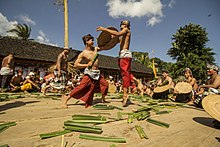
Mekare-kare pandan battle in Tenganan hamlet, Karangasem, Bali.
Mageret pandan is a Balinese method of fighting using a sharp, thorny pandan social club paired with a shield. It is sometimes called makare-kare in Balinese and known as perang pandan in Indonesian, literally meaning "pandan battle". Mageret pandan is practiced by the Bali Aga population of Tenganan village in Karangasem Regency. The people of Tenganan are devotees of the deity Indra. To honour Indra equally a warrior god, many major religious festivals in Tenganan involve a ritualistic battle.
The tradition of mageret pandan is said to have originated with King Maya Denawa who claimed himself a god greater than the entire Hindu pantheon. He forbade the people from performing their religious ceremonies, which angered the gods. Indra himself fought and defeated Maya Denawa for his blasphemy, and their battle was commemorated through mageret pandan.[14]
Today it is done equally a ritual to honor the gods and the ancestors. The weapon used in mageret pandan is a fifteen cm club made by tying ten-15 leaves of pandan (Pandanus amaryllifolius) together. Each of the leaves is edged with minor sharp thorns. The shield is a rattan buckler. Techniques are mostly swinging strikes, but grappling is used when in-fighting. Participants compete shirtless, wearing simply a sarong (kamen) and traditional headdress (udeng). Co-ordinate to tradition, the mageret pandan is compulsory for Tenganan males. For the young, information technology serves equally a rite of passage into manhood; children as young every bit seven have participated.[xv]
Kabasaran [edit]
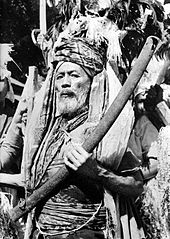
Kabasaran is a Minahasan state of war dance from North Sulawesi, performed past several men clad in carmine. Kabasaran dancers were traditionally farmers or guards who served as waranei (warriors) when the hamlet was attacked.[16] The waranei status along with their weapon is inherited from father to son.[xvi]
The basic structure of the dance consists of ix dance moves (jurus) using either the sword (santi) or spear (wengkouw). The footwork design consists of two steps to the left and another 2 to the right. Dancers are known as kawasalan indicating a pair of fighter cocks.[16] The dance is accompanied by percussion instruments such as gongs, drums or kolintang called pa 'wasalen.
Sitobo Lalang Lipa [edit]

Reenactment of sitobo lalang lipa or tarung sarung, dueling in a sarong using badik, found in Bugis culture in the past.
Sitobo lalang lipa or Sigajang laleng lipa is the Bugis term for a blazon of knife duel formerly practiced by pesilat of the Bugis-Makassar communities and also in Batak tribes. The challenger stands with a loosened sarong around him and invites the other man to footstep into the sarong. Knives in their right hands, the 2 duellists fight to the death within the confines of the sarong. This trigger-happy method was used for conflict resolution in Bugis-Makassar community in the past. If 2 men having disputes that can not be resolved through parley, their honour has been trespassed, and none of them admitted their mistakes, the only way to resolve this dispute is through a deadly duel in a sarong.[17]
In Bugis civilisation, there are three important concept that should be uphold; Ade (adat) or traditional community, Siri (shame or self worth) or in this case ane's pride and laurels should be protected fiercely to avoid the shame of humiliation, and Pesse (compassion). In Bugis culture, the Siri aspect is the most dominant, thus conflict regarding one'due south laurels might occur.[17]
This method of fighting originated in ancient Bharat where the duellists fought with knives in their right hands while their left hands were tied together. It is unknown in what role of Southeast Asia this duel was beginning introduced, but it was expert in Thailand where the fighters boxed each other with the right hands. Duelling inside a sarong rather than tying the hands together appears to be unique to Indonesia. Among the Bugis and Mangkasara, the weapon used in sitobo lalang lipa is the badik. The Batak yet utilise some other type of knife known every bit the raut. Duelling is no longer good today, but reenactments of sitobo lalang lipa are nonetheless performed at cultural shows in Indonesia.[17]
Weapons [edit]

Nias warrior armed with spear and shield
- Badik : a knife or dagger developed by the Bugis and Makassar people of southern Sulawesi
- Chabang : short-handled trident, literally meaning "co-operative"
- Cambuk / Pecut : whip, might be made from various materials; rattan, bamboo, fabrics, leather to stingray's tail
- Celurit/ Sabit : a sickle, normally used in farming, cultivation and harvesting of crops.
- Kerambit/ Kuku Macan : a bract shaped like a tiger's claw
- Kipas : traditional folding fan preferably made of hardwood or iron.
- Klewang : a blazon of single-edge longsword with a protruding notch about its tip.
- Kris : a dagger, frequently with a wavy blade made by folding unlike types of metal together and so washing it in acid.
- Kujang : Sundanese blade roughly shaped like a deer's antler.
- Parang/ Golok : machete usually used in daily tasks such as cutting through wood brush.
- Pedang : sword, either straight or curved
- Rencong/Tumbuk Lada : slightly curved Aceh and Minang dagger, literally pregnant "pepper grinder".
- Samping/Linso : silk sash worn around the waist or shoulder, used in locking techniques and for defence against blades.
- Sundang : a double edge Bugis sword, often wavy-bladed
- Tameng/ Perisai : shield made of hardwood, weaved rattan, or sometimes metal.
- Tombak/ Lembing : spear or javelin made of bamboo, steel or wood that sometimes has horsehair attached about the bract.
- Toya : rod or staff made from forest, steel or bamboo.
- Trisula : a trident or iii-pronged spear
In popular culture [edit]
Republic of indonesia has showcased its martial arts in cinema, novels, comics, theatre, and TV series for decades. The term silat every bit a genre refers specifically to historical stories involving martial artists. These need not necessarily characteristic the silat subject itself, but also includes Chinese wuxia and Japanese jidaigeki. The silat genre began as an oral and theatrical tradition before kickoff being written in the form of medieval hikayat. The modern silat novel was a 20th-century evolution of the literary silat genre, giving rise to comics and eventually movies. Early silat films (as with many gimmicky TV serial today) placed less accent on the actual fights and more on drama, resulting in poor depictions of the art. This inverse in the 1980s due to the popularity of radio shows featuring pencak silat experts in the old Indonesian kingdoms of Pajajaran and Majapahit circa the xiv-15th century. Historical epics such as Saur Sepuh, Tutur Tinular and Misteri Gunung Merapi take been adapted both for TV and moving picture. Indonesian picture palace differentiates this from modern activity films or laga. The latter may or may not include traditional fighting styles, but the modernistic setting makes it distinct from the silat genre proper.
While Indonesian movies and TV series accept ever had a large following in neighbouring Malaysia and Singapore, information technology was the 2009 flick Merantau that brought international attention to the cinematic genre and pencak silat in general. The motion-picture show had a mostly positive reaction from movie theater critics[eighteen] and generated enough interest for the lead player to follow up with The Raid: Redemption in 2011 which received international acclamation. Its sequel The Raid 2: Berandal was similarly well-received but drew much criticism for its farthermost gore,[xix] [xx] leading to the film existence banned in Malaysia.[21]
Run across likewise [edit]
- Styles of silat
- Military history of Indonesia
References [edit]
- ^ a b "Pencak Silat: Techniques and History of the Indonesian Martial Arts". Black Chugalug Magazine. Archived from the original on xiv September 2017. Retrieved half dozen July 2015.
- ^ Donn F. Draeger (1992). Weapons and fighting arts of Indonesia. Rutland, Vt. : Charles E. Tuttle Co. ISBN978-0-8048-1716-v.
- ^ "Silek Harimau Minangkabau: the True Martial Art of West Sumatra". Wonderful Indonesia. Retrieved viii July 2015.
- ^ Howard Alexander, Quintin Chambers, Donn F. Draeger (1979). Pentjak Silat: The Indonesian Fighting Fine art. Tokyo, Japan : Kodansha International Ltd.
{{cite volume}}: CS1 maint: multiple names: authors list (link) - ^ a b c d e Draeger, Donn (1992). Weapons & Fighting Arts of Indonesia (Tuttle martial arts ed.). Tuttle Publishing. ISBN9781462905096 . Retrieved 11 Nov 2015.
- ^ Indra Harsaputra (5 April 2013). "Manifesting force and dear". The Djakarta Postal service. West Manggarai, Due east Nusa Tenggara. Retrieved 21 September 2015.
- ^ Agnes Winarti (13 November 2011). "Tarung derajat looking for bigger phase". The Jakarta Post. Jakarta. Retrieved 11 November 2011.
- ^ "Tarung Derajat Tampil di SEA Games 2011". Tempo. Archived from the original on 24 September 2015. Retrieved 11 November 2015.
- ^ "Indonesian island sees hereafter in age-sometime horseback battle". The Star. iii April 2014.
- ^ Suryadi Gunawan. "'Payuq', 'Bebintih' Roh Para Pegulat Kaltim di Ajang Internasional". Antara News.com (in Indonesian). Retrieved 11 November 2015.
- ^ a b c Husain (iv May 2012). Glori M. Wadrianto (ed.). "Menyaksikan Tradisi "Sisemba" di Toraja Utara". Kompas Travel (in Indonesian). Retrieved eleven November 2015.
- ^ P. Due east. De Josselin De Jong (1984). Unity in Diversity: Indonesia equally a Field of Anthropological Study. Foris Publications. ISBN9-0676-5063-iii.
- ^ Albert G Van Zonneveld (2002). Traditional Weapons of the Indonesian Archipelago. Koninklyk Instituut Voor Taal Land. ISBNnine-0545-0004-2.
- ^ Luh De Suriyan (13 July 2016). "Melihat Aneka Ritual Kesadaran Lingkungan di Desa Sosialis Tenganan Pegringsingan". Mongabay republic of indonesia (in Indonesian).
- ^ Anton Muhajir (18 June 2009). "Ritualistic battle honors the ancestors". The Jakarta Mail service. Tenganan. Retrieved 21 September 2015.
- ^ a b c "Tarian Kabasaran". Republic of indonesia Kaya (in Indonesian).
- ^ a b c "Membela Harga Diri Lewat Tradisi Sigajang Laleng Lipa di Makassar". kumparan (in Indonesian). Retrieved ten Apr 2020.
- ^ Dark-brown, Todd (23 July 2009). "PiFan 09 Review: MERANTAU". Twitch Picture show. Archived from the original on 27 July 2009.
- ^ "Review: The Raid 2 is too gory to stomach". Rediff. 30 May 2014.
- ^ "Paramedics Called To 'Raid 2' Premiere: 'The Most Fierce Mainstream Film Since Passion Of The Christ'". UPROXX.
- ^ "The Raid 2: Berandal banned due to excessive violence". astroawani.com.
Farther reading [edit]
- Quintin Chambers and Donn F. Draeger (1979). Javanese Silat: The Fighting Fine art of Perisai Diri. ISBN0-87011-353-4.
- Sean Stark (2007). Pencak Silat Pertempuran: Vol. 1. Stark Publishing. ISBN978-0-615-13968-five.
- Sean Stark (2007). Pencak Silat Pertempuran: Vol. ii. Stark Publishing. ISBN978-0-615-13784-1.
- O'ong Maryono (2002). Pencak Silat in the Indonesian Archipelago. ISBN9799341604.
- Suwanda, Herman (2006). Pencak Silat Through my eyes. Los Angeles: Empire Books. p. 97. ISBN9781933901039.
- Stonemason, P.H. (2012) "A Barometer of Modernity: Village performances in the highlands of West Sumatra," Admission: Critical Perspectives on Communication, Cultural & Policy Studies, 31(2), 79–xc.
montgomerythempans.blogspot.com
Source: https://en.wikipedia.org/wiki/Indonesian_martial_arts
0 Response to "What Is the Worlds Most Popular Martial Art? Answerscom"
ارسال یک نظر