Reputison Is When You Hear Something Over and Over Again
"Again!" My four-yr-old son Edwin likes to yell over and over again when he finds a new activeness or joke that he likes. My 16-month-sometime, Charlie, likes to repeatedly throw objects on the flooring from his high chair or even against the wall if information technology makes an interesting sound. They both like to hear the same stories every night earlier bed, they like to consume the aforementioned foods for dejeuner, they like to play with the same toys and spotter the same movies every solar day. When they observe something they like, they want to do it over and over and over once more.
Why do children like repetition so much? An early developing preference for the familiar is actually quite common in infancy and early childhood. These preferences begin to develop earlier a baby is even built-in—in the 3rd trimester of pregnancy. At that signal, fetuses can taste, smell, and hear, and equally a outcome, at this time, they begin to develop preferences for familiar flavors from their mother's food in the amniotic fluid that floats around them (Schaal, Marlier, & Soussignan, 2000; Menella, Jagnow, & Beauchamp, 2001). They also develop preferences for familiar sounds, like the sound of their mothers' phonation (Kisilvesky et al., 2003), their native language (Moon, Cooper, & Fifer, 1993), or fifty-fifty familiar stories that are read to them from outside the womb (DeCasper & Spence, 1986). This tendency continues after they're built-in, and only after a few hours of exposure, newborns develop a fast preference for their mother's face (Field, Cohen, Garcia, & Greenberg, 1984). Soon after, they develop preferences for faces in full general (Johnson & Morton, 1991), all based on familiarity.
This preference for the familiar might be adaptive—creating an early on analogousness for the people that are about probable to take care of them.
So perhaps information technology's not surprising that children like to read the same books, watch the same movies, and sing the aforementioned songs on repeat every day. In fact, in that location is evidence that this repetition might fifty-fifty support learning.
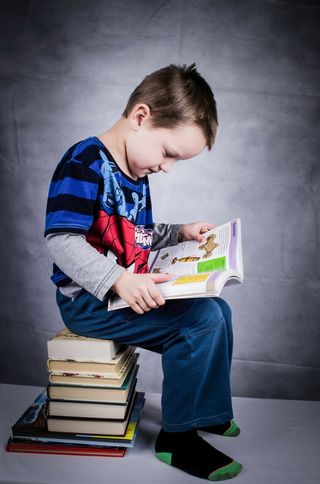
Source: PublicDomainPictures/Pixabay
Not surprisingly, enquiry has shown that children learn ameliorate from reading a book over and over again than simply reading it once or twice. In one study, researchers presented 3-year-erstwhile children with the aforementioned new words in three stories over the course of a week. The new words were exactly the same for all children, but one-half of the children were presented with the words in the aforementioned verbal story repeated three times, while the others heard the same words in three different stories. Children learned the words better when they heard the aforementioned story repeated than when they heard the same words presented in iii unlike stories (Horst, Parsons, & Bryan, 2011).
The aforementioned trends accept been plant for babies. In a like report, researchers presented 18- to 24-month-olds with a storybook that detailed specific actions needed to make and shake a toy rattle. Infants were read the book either twice or 4 times, and the researchers found that the more than the babies were read the book, the more they imitated the deportment they learned (Simcock & DeLoache, 2008). Repeated exposure to actions presented on television likewise leads to more frequent imitation (Barr, Muentener, Garcia, Fujimoto, & Chavez, 2007).
People often say that exercise makes perfect. Research certainly supports this, specially in children. In fact, studies accept shown that repetition tin can exist critically important for learning in general (eastward.g., Karpicke & Roediger, 2008)—especially for retentiveness (Hintzman, 1976) and language learning (Schwab & Lew-Williams, 2016). So while adults can hands pick upward new information from a single exposure, when kids ask to picket the aforementioned picture show they've already seen a hundred times or read the same book before bed for the 10th night in a row, it might just be their way of learning the storyline. And although information technology might be boring or even abrasive to do the aforementioned affair over and over and over (and over and over) again, this extra practice might be merely what children need to learn new things.
References
Barr, R., Muentener, P., Garcia, A., Fujimoto, Grand., & Chávez, V. (2007). The effect of repetition on fake from television during infancy. Developmental Psychobiology, 49(2), 196-207.
DeCasper, A. J., & Spence, 1000. J. (1986). Prenatal maternal spoken language influences newborns' perception of speech sounds. Infant Behavior and Development, 9, 133-150.
Field, T. M., Cohen, D., Garcia, R., & Greenberg, R. (1984). Mother-stranger face discrimination by the newborn. Babe Behavior and development, 7(1), 19-25.
Hintzman, D. Fifty. (1976). Repetition and retention. In Psychology of learning and motivation (Vol. 10, pp. 47-91). Academic Press.
Horst, J. S., Parsons, 1000. Fifty., & Bryan, Northward. M. (2011). Become the story direct: Contextual repetition promotes word learning from storybooks. Frontiers in Psychology, ii, 17.
Johnson, Thou. H., & Morton, J. (1991). Biology and cognitive development: The case of face recognition. Oxford, England: Basil Blackwell.
Karpicke, J. D., & Roediger, H. L. (2008). The critical importance of retrieval for learning. Science, 319(5865), 966-968.
Kisilevsky, B. S., Hains, S. M. J., Lee. K., Xie, 10., Huang, H., Ye, H. H., Zhang, Grand., & Wang, Z. (2003). Effects of experience on vocalism recognition. Psychological Science, 14, 220-224.
Mennella, J. A., Jagnow, C. P., & Beauchamp, G. K. (2001). Prenatal and postnatal flavor learning by human infants. Pediatrics, 107(6), E88.
Moon, C., Cooper, R. P., & Fifer, W. P. (1993). Two-day-olds adopt their native language. Infant behavior and development, 16, 495-500.
Schaal, B., Marlier, L., & Soussignan, R. (2000). Human being fetuses larn odours from their significant female parent's diet. Chemical Senses, 25, 729-737.
Schwab, J. F., & Lew-Williams, C. (2016). Repetition across successive sentences facilitates young children's discussion learning. Developmental Psychology, 52(6), 879-886.
Simcock, G., & DeLoache, J. South. (2008). The effect of repetition on infants' imitation from moving picture books varying in iconicity. Infancy, 13(6), 687-697.
montgomerythempans.blogspot.com
Source: https://www.psychologytoday.com/us/blog/the-baby-scientist/201907/why-children-repetition-and-how-it-helps-them-learn
0 Response to "Reputison Is When You Hear Something Over and Over Again"
ارسال یک نظر